A Short History of the Harmonium: From Paris to India
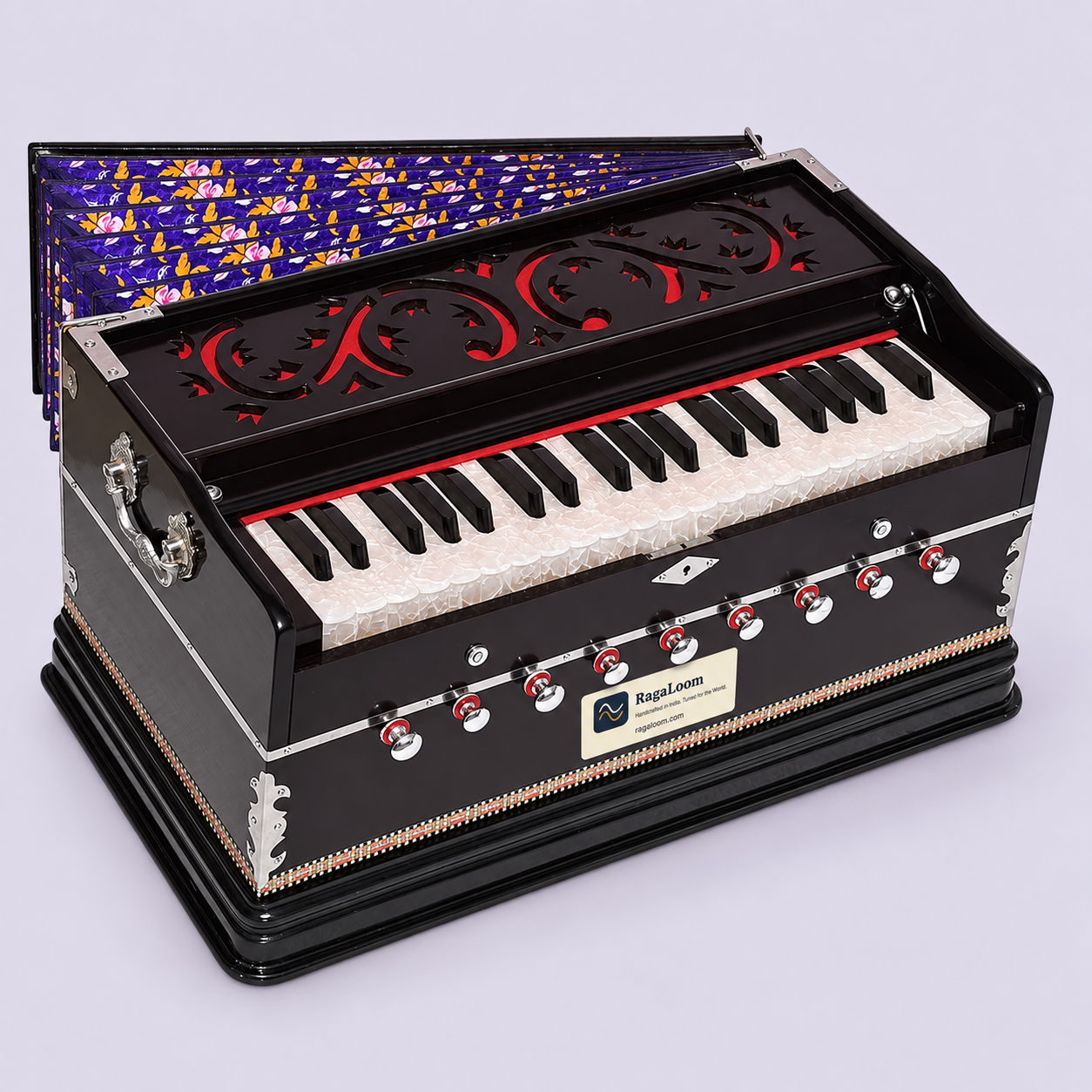
Few instruments feel as Indian as the harmonium, yet it did not begin in India. Its story crosses Paris, colonial Calcutta, the radio studios of independent India and modern kirtan circles from Berlin to Brisbane. This short history of the harmonium explains where the harmonium came from, how it became part of Indian music, and what that means if you want to buy one today.
From a European reed organ to the harmonium
The word “harmonium” is generally traced to Paris in the first half of the 19th century. Instrument makers there were developing small keyboard reed organs, in which air passes over thin metal reeds to make a sound. The inventor Alexandre Debain is usually credited with patenting an instrument under the name “harmonium” in 1840. These early harmoniums were foot-pumped: the player worked pedals to push air through the reeds while playing a keyboard.
This design was compact, loud for its size and needed no tuning once built, which made it popular in homes and churches across Europe.
How the harmonium reached India
During the 19th century, European reed organs travelled with missionaries and traders to India. They were a practical way to accompany hymns, and many Indian musicians were curious about an instrument that could hold a note steadily and did not need tuning like a string instrument.
Over time, Indian makers adapted the design. A major change was moving from a foot-pumped instrument to a hand-pumped one, with the bellows at the back and the player sitting on the floor. Dwarkanath Ghose of Calcutta is widely credited with an influential hand-pumped design in the later 19th century. This version suited the way Indian musicians sit and perform, and it is the type of harmonium people usually mean today.
Why musicians embraced it
The harmonium solved real problems for singers and teachers:
- Steady pitch. Reeds hold a note, which helps a singer practise and stay on pitch.
- Portability. A hand-pumped harmonium is far easier to carry and set up than a foot-pumped organ.
- Volume. It carries well in a room, and in a hall or temple.
- Simplicity. It needs little maintenance compared with many string instruments.
For bhajan, kirtan and devotional singing, these qualities made it a natural accompaniment. It became common in homes, temples and community gatherings across India.
A contested place in classical music
Not everyone welcomed it. Critics argued that the harmonium’s fixed, equal-tempered keys could not reproduce the delicate microtonal ornaments and slides found in many Indian ragas. All India Radio is widely reported to have restricted the harmonium on its broadcasts from 1940, and the restriction was lifted in 1971. Even so, singers and teachers continued to use it in practice and performance, and many still do. This ongoing debate is part of the instrument’s history rather than a verdict on it.
How the instrument works
Whatever its origin, the principle is the same. Each key opens a small valve above a brass reed. When you pump the bellows, air flows over the reeds that are open and makes them vibrate. Stops let you switch reed sets on or off, so the same keyboard can sound softer or fuller, and a coupler adds a second reed an octave away for a bigger sound. Because the reeds are fixed in pitch, a harmonium must be tuned by its maker, and a good instrument is checked before it is sent out.
The harmonium today
Today the harmonium is used in classical vocal training, devotional music, folk traditions, film music and the worldwide kirtan movement. Makers in India now offer many variations: standard 39-key models, larger 42-key instruments with more stops, and folding travel models.
RagaLoom’s harmoniums are handcrafted in India, tuned to A=440 Hz as standard and checked before dispatch. You can browse them in our harmoniums category. If you are new to the instrument, start with the harmonium buying guide for beginners, or compare it with a drone instrument in harmonium vs shruti box.
Which type suits you?
- For leading chant, see our kirtan harmoniums.
- For carrying to classes or festivals, see the travel harmoniums, for example the Compact Dulcetina Harmonium.
- For help comparing models, read which harmonium is best.
- Looking after an older or newer instrument? Our harmonium care guide covers humidity and storage.
Buying a harmonium from abroad
If you are in the US, UK, Canada, Australia, Europe or the Gulf, you can order from India with FedEx/DHL. Our shipping page lists the countries we ship to and the rates: a base rate for your destination plus $25 per item. Customs duties and import taxes are not included in the price and are paid by the buyer. Our returns policy allows 30 days for orders under $600 and 10 days for orders of $600 or more, with the buyer paying return shipping and customs.
Questions about an instrument? Email info@ragaloom.com or contact us on WhatsApp at +91 75033 59491.
Frequently asked questions
Where was the harmonium invented?
The harmonium as a named instrument is generally traced to Paris in the 1840s, where Alexandre Debain is usually credited with patenting it.
When did the harmonium come to India?
European reed organs arrived in India during the 19th century, and Indian makers adapted them into the hand-pumped harmonium used today.
Why was the harmonium restricted on All India Radio?
Critics felt its fixed keys could not express the microtones of Indian ragas. The restriction is widely reported to have begun in 1940 and ended in 1971.
Is the harmonium used in kirtan?
Yes. It is the core instrument of kirtan, holding the drone and carrying the melody.
What pitch are RagaLoom harmoniums tuned to?
They are tuned to A=440 Hz as standard and checked before dispatch.
Related articles
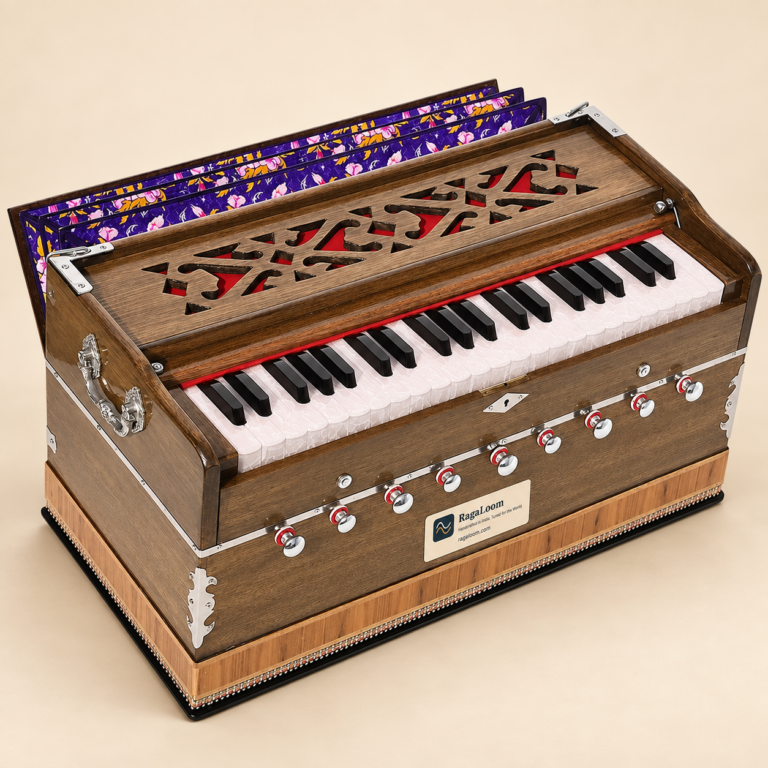
Harmonium for Kirtan Singers: Getting Started Abroad
If you have just started to sing kirtan, or you have been asked to lead a circle at your local yoga studio, temple or community…
Read article →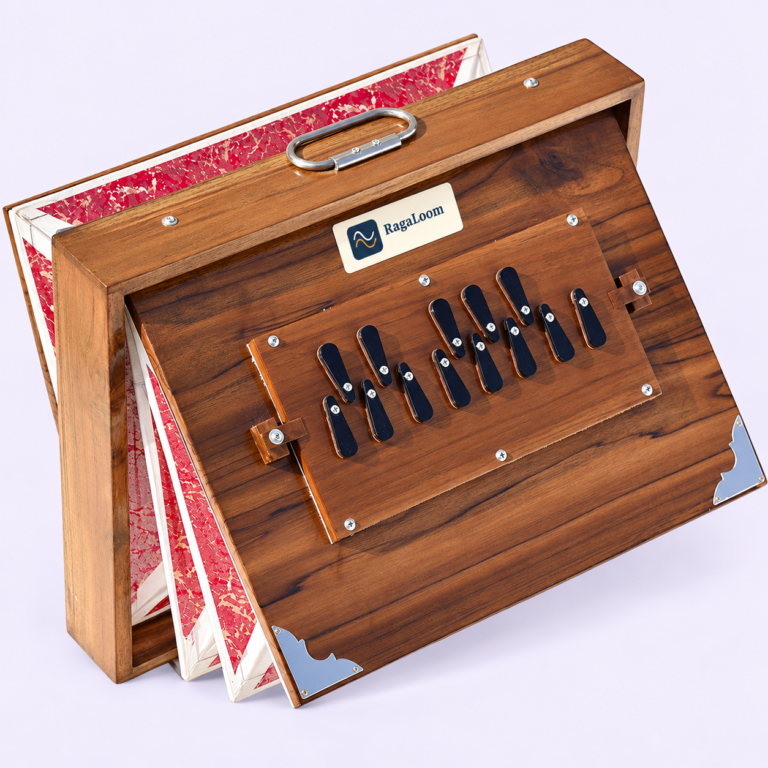
Shruti Box Tuning and Care: What You Can (and Can’t) Do at Home
A shruti box is one of the simplest instruments you can own. It has no electronics, no keyboard and very few moving parts, which is…
Read article →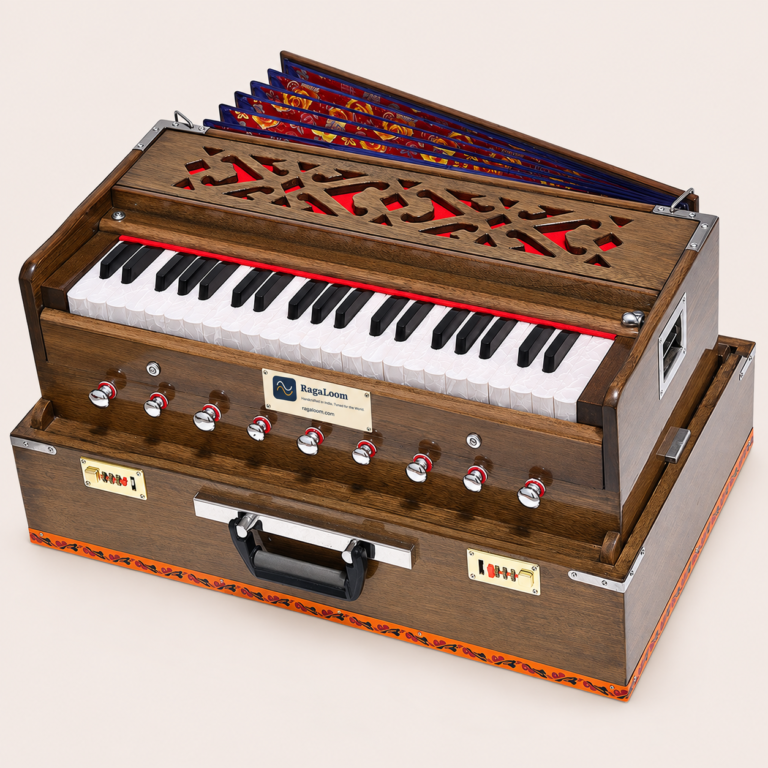
Importing an Indian Instrument: Customs, Duties and Taxes Explained
Importing an Indian instrument is straightforward, but the part that surprises most first-time buyers is what happens at the border. This guide explains customs duties…
Read article →